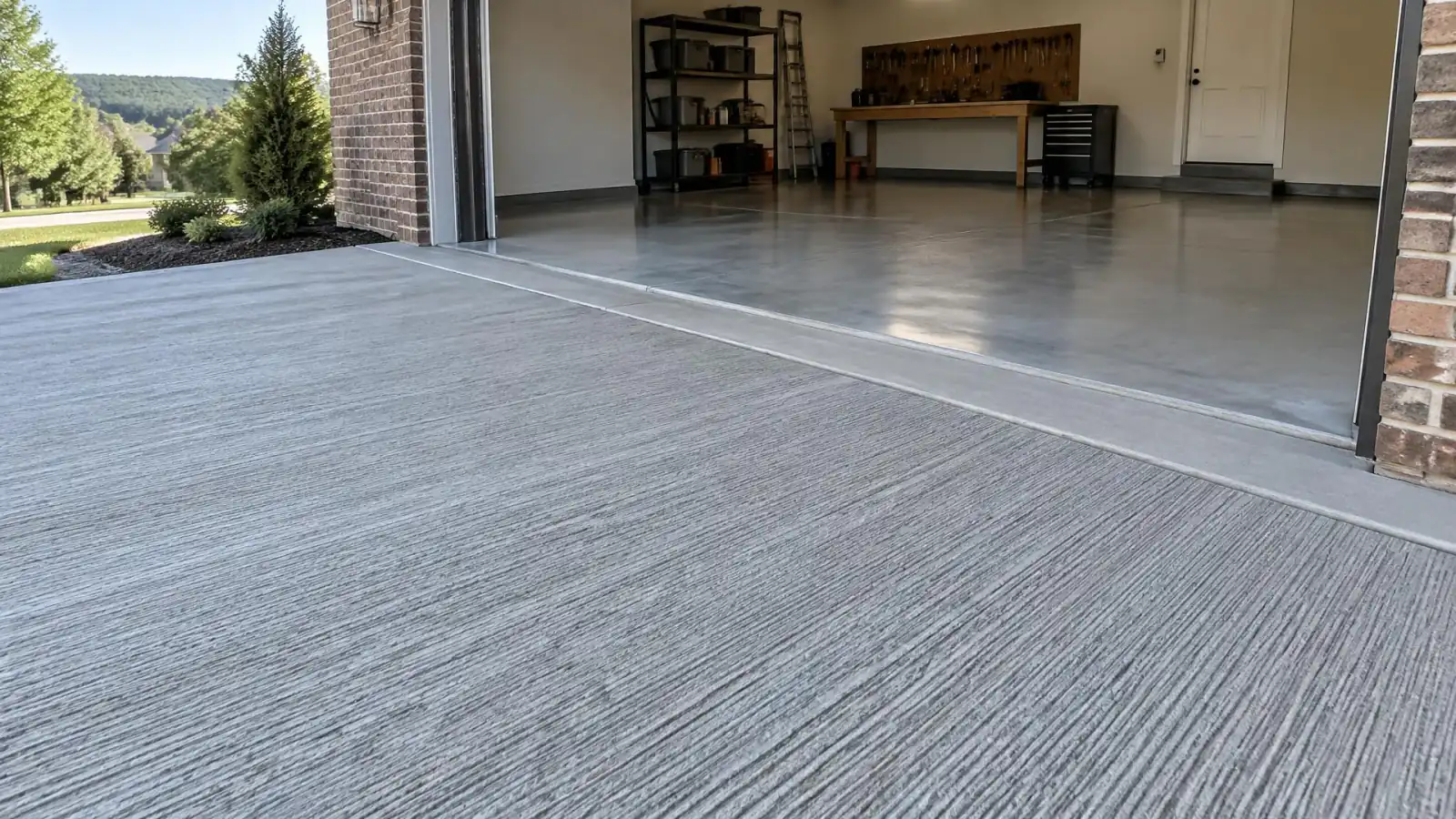
Every slab we pour gets the same first question at the estimate: what finish do you want on it? Most people have never had to think about it, and a fair few answer "smooth" because smooth sounds like the more finished, more expensive option. Sometimes it is. Outdoors it is also the answer most likely to put somebody on their back in February. The finish is not decoration — it is what determines the surface's texture, its traction, how it cleans, how it weathers and how it copes with salt. Getting it right is worth five minutes of conversation before the concrete arrives.
Start with the broom finish, because it is the default outdoors and most of what we pour. After the slab is placed, screeded and floated, and after the edges and the control joints are tooled, the surface is drawn with a broom in one direction across the whole pour. That leaves a fine, regular texture, and that texture is grip. It is enough to hold a shoe or a tyre on a wet or frosted driveway without being coarse enough to skin a knee or to catch dirt that never comes out again. It is also forgiving: a broom texture hides minor variations in a way a mirror surface never will. If your slab is outside — a driveway, an apron, a sidewalk, a patio, a porch, a generator pad — this is almost certainly the right answer.
A slick finish is the opposite job and belongs indoors. The slab is floated, then left alone to stiffen, then worked with a power trowel over several passes with the blades progressively lifted, which closes and densifies the surface until it is flat and very nearly polished. On a garage, basement, workshop or warehouse floor that is exactly what you want: nothing catches in it, dust and oil sweep straight off, and it will take an epoxy or a sealer without being ground first. The catch is that a hard-trowelled surface is slippery when wet. Indoors, where water is the exception, that is manageable. On an outdoor slab in a Tennessee rainstorm it is a hazard, and we will tell you so rather than pour it.
The timing on a slick finish is worth understanding, because it is the main thing you are paying for. There is a window — sometimes a couple of hours in April, sometimes twenty minutes in August — where the slab is firm enough to walk a trowel on but still open enough for the blades to close it. Troweling too early works bleed water down into the surface, and that slab will dust and scale within a year or two. Troweling too late and the blades skate over concrete that has already set, and it never closes at all. There is no second attempt. This is why we watch the slab rather than the clock, and why a crew standing around apparently doing nothing is often a crew doing the job correctly.
Then there is stamped concrete, which is a broom finish's decorative cousin. Colour goes in two ways — integral through the mix, and a release powder broadcast on top that both stops the mats sticking and shadows the texture so it reads as stone rather than as tinted concrete. Patterned mats are pressed into the surface in sequence during a similar narrow window, edges and corners are detailed by hand, and the whole thing is washed and sealed once cured. It gets you the look of cut stone, slate, brick or plank in one continuous slab with no joints for weeds and nothing to settle or come loose. The trade-off is maintenance: sealer needs renewing every two to three years, and on a south-facing patio here, closer to two.
The fourth is the washed finish, which the trade also calls exposed aggregate. A surface retarder goes on straight after floating to hold the top skin of cement paste open while the concrete underneath sets, then that paste is washed and brushed off at the right hour to leave the stone in the mix standing proud. What you get is a surface made of aggregate: heavily textured, genuinely non-slip even soaking wet, and much more resistant to the surface scaling that road salt causes on a smooth slab. It is the right answer for a pool deck, a set of steps, or a driveway on a grade — which in Seymour, Maryville or anywhere in the foothills is a lot of driveways. It is also the least forgiving to place, because the wash-back timing is a one-shot decision.
So the short version. Indoors, on a floor that has to be flat, clean and coatable: slick finish. Outdoors, on anything you walk or drive on: broom finish. Outdoors where you want it to look like something other than concrete: stamped. Outdoors where traction or salt resistance matters most — slopes, steps, pool surrounds: washed. And the one combination to avoid entirely is a hard-trowelled slab anywhere it rains.
If you are weighing up a driveway, a patio or a garage floor and are not sure which of those your job wants, that is exactly what the free estimate is for. Call CHR Home Construction on (423) 599-5316 and we will walk the site with you, tell you plainly what it needs and why, and price it before anything starts — anywhere in Knoxville, Alcoa, Maryville, Lenoir City, Oak Ridge, Clinton, Seymour or across East Tennessee.