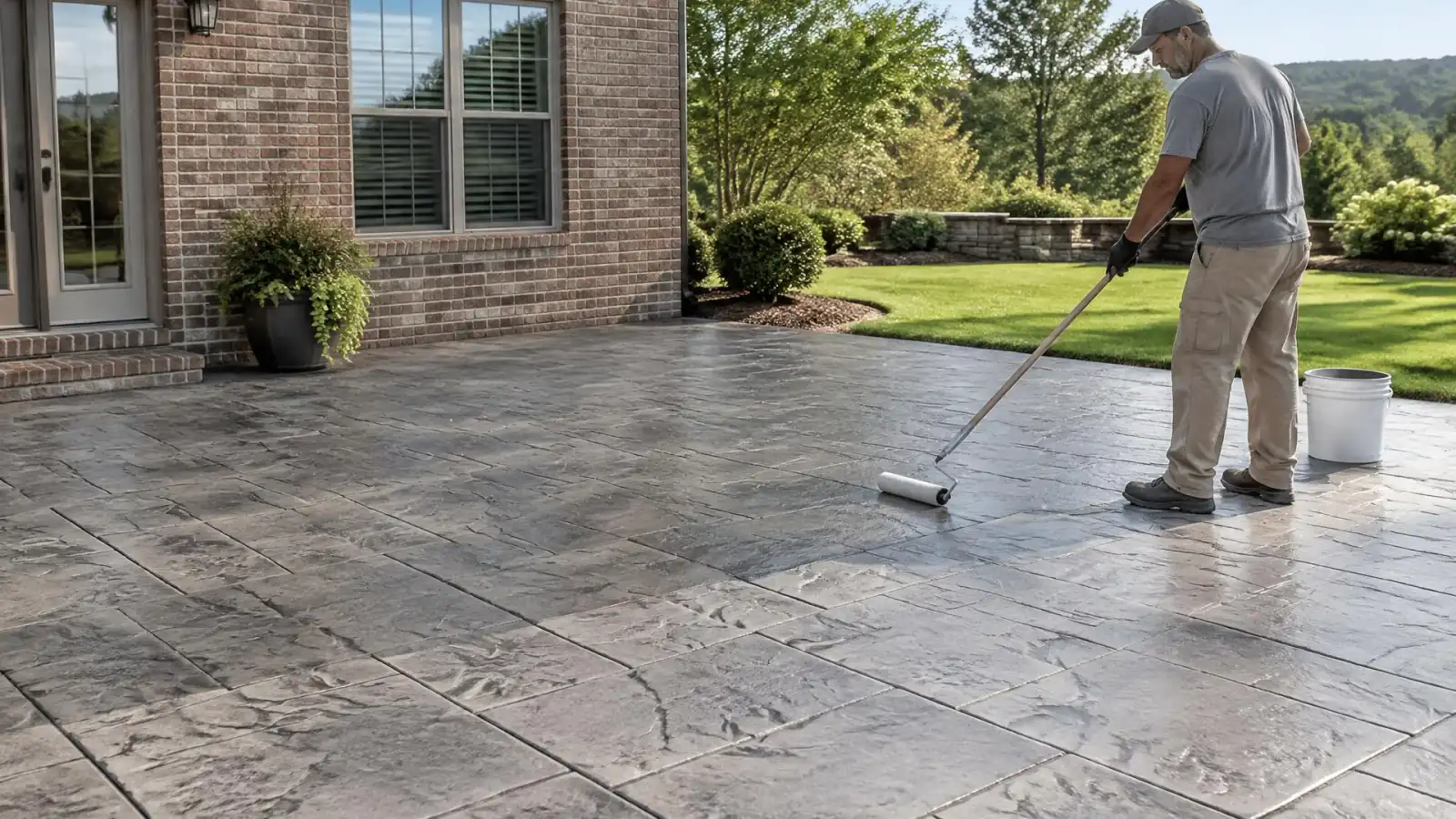
Stamped concrete is the most requested decorative work we do, and it is genuinely good value — but it is sold badly often enough that it is worth laying out what you actually get and what it asks of you afterwards. The pitch is simple: the appearance of cut stone, slate, brick or timber plank, at a fraction of what laying the real material costs, in one continuous slab. The part that usually goes unmentioned is that it is a coated surface, and coatings need renewing.
Take the upside first, because it is real. A paver or flagstone patio is hundreds of individual pieces sitting on a bed, and every joint between them is a place for weeds to root, ants to nest and water to work down into the base. Over a decade those pieces move independently — one lifts, one drops, one rocks — and re-levelling them is its own job. A stamped slab is a single monolithic piece of concrete with the pattern pressed into its surface. Nothing to settle independently, nothing to come loose, nothing to weed. You sweep it and hose it, and that is the routine maintenance.
How it is made explains most of its behaviour. The slab is poured and floated flat like any other, then colour is introduced in two ways: an integral colour mixed through the concrete itself, which means the colour goes all the way down rather than sitting on top, and a release powder broadcast across the surface, which stops the mats sticking and settles into the texture so the finished surface has depth and shadow instead of reading as one flat tinted slab. Then the mats go down, in sequence, during the same narrow window that governs every other finish — firm enough to hold an impression, soft enough to take one. Edges, corners and anywhere a mat cannot reach get detailed by hand, and that hand-work is where you can tell a good stamped job from an average one.
Once it has cured, the loose release is washed off, the control joints are cut, and the slab is sealed. The sealer is not a finishing flourish — it is what brings the colour up to the depth you were shown on the sample, and it is what keeps stains, salt and UV off a decorative surface. An unsealed stamped slab looks chalky and washed out within a season. That is the trade-off in one sentence: you avoid the weeding and re-levelling that pavers ask for, and in exchange you take on resealing.
How often? Plan on every two to three years. A shaded north-facing walk can stretch toward three or four; a south-facing patio in full Tennessee sun, or a driveway that gets salted, is closer to two. The job itself is not dramatic — clean it thoroughly, let it dry completely, roll or spray the sealer on. The common mistakes are sealing a damp slab, which traps moisture and clouds the finish white, and building up coat on coat over the years until the surface goes plasticky and starts to peel. Less, more often, on a properly cleaned slab.
Two more things worth knowing before you choose a pattern. First, a heavily textured pattern with deep relief looks spectacular in a photograph and is harder to shovel snow off and to sweep out; a subtler texture or a seamless stone pattern lives more easily day to day. Second, sealed stamped concrete is slicker underfoot than a broom finish, particularly when it is wet. If the area is a pool surround, a set of steps or anything on a slope, ask for a grit additive in the sealer — it is a small extra that makes a real difference, and we would rather add it than have you find out the hard way.
On cost: stamped runs meaningfully above a plain broom finish per square foot, because it is more material and considerably more skilled labour under time pressure, and it sits well below natural stone laid properly. Where it tends to make the most sense is patios, front entry walks, porches and pool surrounds — places that are seen, that are not very large, and where the difference between plain grey concrete and something with pattern and colour changes how the whole back of a house reads. On a large driveway the numbers get harder to justify unless the look genuinely matters to you, and we will say so.
If you are thinking about a stamped patio or walk, come and look at real samples rather than photographs on a screen — colour on a monitor is not colour in sunlight. Call CHR Home Construction on (423) 599-5316 and we will bring them out, walk the space, and give you a written price for stamped and for a plain finish side by side so you can see exactly what the upgrade costs. We pour across Knoxville, Maryville, Alcoa, Louisville, Lenoir City, Seymour and the rest of East Tennessee.