When a driveway fails, people assume they got bad concrete. Almost always they got fine concrete on a bad base. We break out slabs every year that have cracked into rocking sections, dropped an inch at one corner or crumbled along an edge, and when the pieces come up you can usually read exactly what went wrong in the dirt underneath: soft spots that were never compacted, no stone at all, a slab poured two inches thinner than it should have been, or joints that were never cut so the slab decided for itself where to break. None of that is visible on day one. All of it is decided before the truck arrives.
Start with the sub-grade, because in East Tennessee it deserves a hard look. Much of Knox, Blount and Loudon county is red clay, and clay holds water and moves with it — it swells when it is wet and shrinks back when it dries. Slab on top of it moves too. Elsewhere in the same counties there is limestone sitting shallow enough to hit with a mini-ex, and in between there is old fill nobody documented. Three different sub-grades, three different answers, sometimes on the same street. So the first thing that happens on our jobs is that we dig it and look at it, rather than pricing off a square-foot number over the phone and hoping.
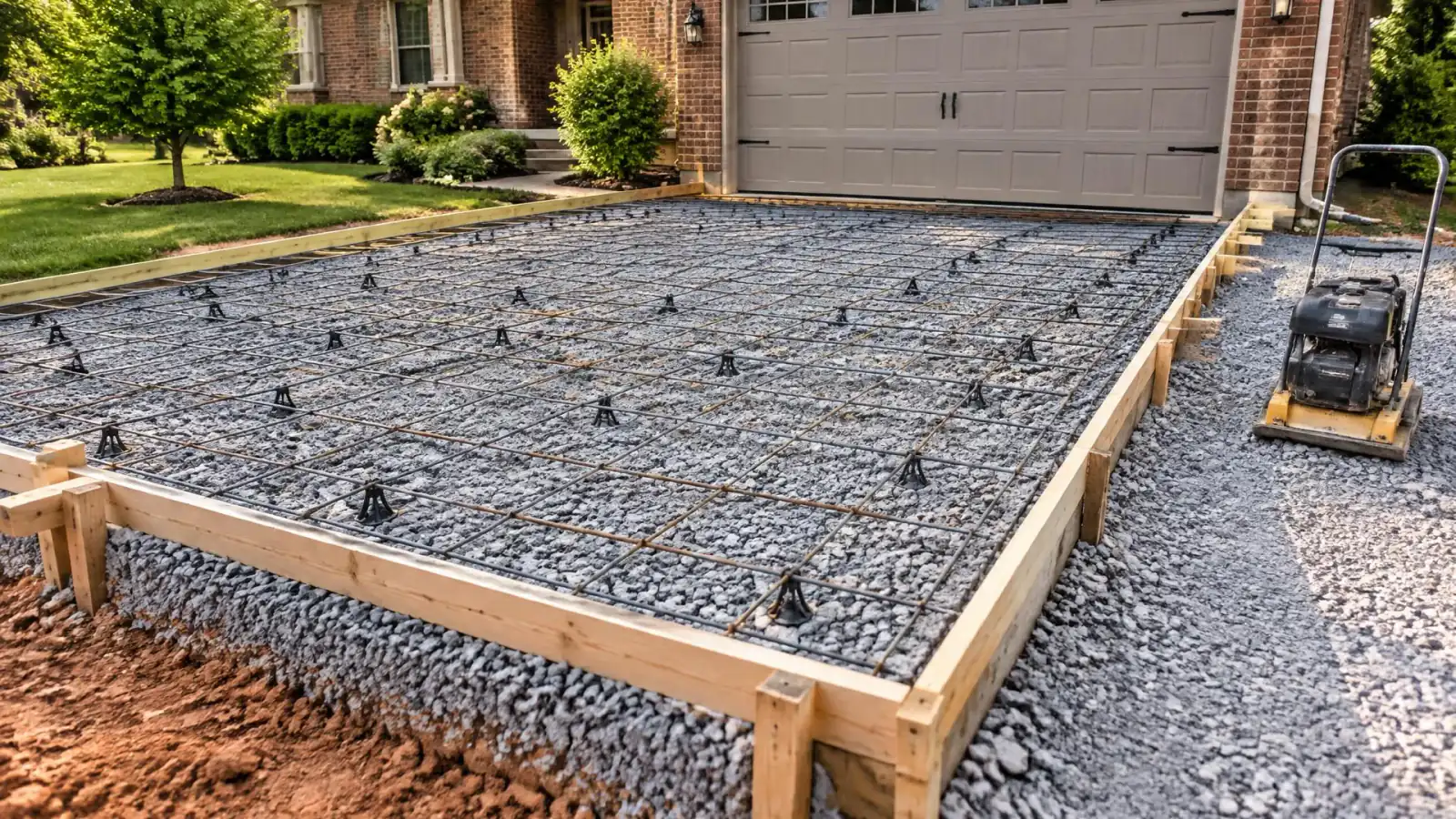
On top of that goes the stone base, and this is where money gets saved in ways that cost later. A properly built base is graded crushed stone — in this region that is usually crusher run, which has fines in it that lock the aggregate together when it is compacted — placed to a consistent depth and compacted in lifts rather than dumped in one go and driven over. Its job is twofold: spread the load from above across a wider area of soil, and give water somewhere to drain instead of sitting against the underside of your slab. A slab poured straight onto clay with no base is a slab that will move with the clay.
Compaction is the step that is easiest to skip and hardest to see afterwards. Loose fill placed in one thick layer looks identical to properly compacted fill from above — right up until a vehicle parks on it and the slab settles into the void. Lifts should be thin enough for the plate compactor or roller actually to reach the bottom of them, and any soft spot found during excavation should be dug out and replaced rather than bridged. If you are getting quotes and one is notably cheaper than the others, this is the first place to ask what is being done.
Then thickness and reinforcement, which go together and depend entirely on what is going to sit on the slab. A footpath is not a car driveway, and a car driveway is not a pad that an RV, a loaded trailer or a delivery truck will park on. Reinforcement — wire mesh or rebar — does not stop concrete cracking; nothing does. What it does is hold the two sides of a crack together so the slab keeps acting as one piece instead of becoming two pieces at different heights. For that to work it has to sit in the body of the slab, on chairs, not lying on the stone where it does nothing. Mesh that was thrown on the ground and never lifted is one of the more common things we find in a failed slab.
Control joints are the last piece and the most misunderstood. Concrete shrinks as it cures. It is going to crack. A control joint is a deliberate line of weakness, cut or tooled to about a quarter of the slab depth, that tells the crack where to go — straight down the bottom of a joint where nobody looks at it. Joints need to be at a spacing suited to the slab thickness, laid out in panels that are roughly square rather than long thin strips, and cut soon enough after the pour to get ahead of the shrinkage. A driveway with no joints will still crack; it will just do it in a jagged line across the middle.
Curing finishes the job and is the cheapest thing on the list to get right. Concrete does not dry, it reacts, and it needs moisture to keep reacting — a slab that loses its water to a hot dry afternoon stops gaining strength and ends up weaker at the surface, which is where the scaling and dusting start. So it gets cured, whether by covering, by a curing compound or by keeping it wet, and in summer here we pour early in the day for exactly this reason. Then it gets left alone: foot traffic after a day or two, cars after a week, heavy vehicles after two to four.
None of this is exotic and none of it is expensive relative to the cost of doing the job twice. It is simply the part of concrete work you cannot inspect once the slab is down, which is why it is worth asking about before you sign anything. If you want a straight answer about what is under your existing driveway, or what would go under a new one, call CHR Home Construction on (423) 599-5316 — we will dig it, look at it, and tell you what we find across Knoxville, Maryville, Alcoa, Oak Ridge, Clinton, Lenoir City and the rest of East Tennessee.